Is fear holding you back? Heres how to take charge
I’m going to admit something here which feels risky. In January 2025, I was paralysed by fear. There. I said it.
/01
I’ve coached others through fear and other self-limiting patterns for decades, so it feels risky to admit that I have a loud inner voice critiquing me for feeling afraid.
AND of course, I know that’s daft: No matter how good we are at helping others through it, no matter how fortunate and privileged our lives, FEAR is a natural and universal part of our human experience.
So, here’s the truth: In January 2025, I was staring down the barrel of uncertainty – and it was terrifying.
This was when we realised that Nkuzi Change, the company that Elise, Martin and I had lovingly built, brick-by-brick, was unviable.
This truth was very difficult to admit. We had a bold vision of a solution to an age old problem faced by all large companies. In 5 years we’d proven our vision and delivered fantastic results. But that’s not enough to be successful. There are always significant barriers for innovators.
By January 2025 we faced a diminishing sales pipeline and a difficult decision. Did we continue pouring energy, time and money into something that had been slowly bleeding us dry of all three? Or did we accept that even brilliant, proven solutions sometimes don’t win out?
For Martin at least the answer was easy. Long-earned retirement beckoned. And after much debate, the three of us agreed we would double down on sales for a final 8 weeks, but unless we signed a minimum of £100k of new business by the end of February, we would make plans to close the business. This would mean saying goodbye to our wonderful employee team. And for me, it meant my salary would stop. We needed Elise and Martin to deliver the programmes that were in train, but there was no need for my role.
My dream of creating a business that was big enough and successful enough to afford me freedom to work less, was slipping through my fingers into a puddle of anxiety.
So, now what? Well, fear mainly. To say I was utterly consumed wouldn’t even come close to describing how heavily this decision weighed on me.
First, I had to tell my husband, Keme, we were closing the business.
Since 2023, as founders we had regularly taken a hit on paying ourselves when cash flow challenges hit, and Keme and I had spent £30k of our savings to supplement my shortfall. I felt guilty and irresponsible. Having drained our savings, I now no longer even had an income.
FEAR is the most contagious of all our emotions.
And in early 2025, fear was in the air that I breathed. I was hearing from my network about how the economy was affecting their own businesses, and I was swept along. My LinkedIn feed was full of stories of amazing people who’d been on the job market for months. I could feel fear in my body as I absorbed those stories, and heard the news about layoffs and growing economic problems.
Was I really in danger?
Now I know that there was no grave risk to my financial security. There are plenty of ways I can earn a good living, even in these strange times. But at the time, my body was having the experience anyway. I felt deeply unsettled, with a whole range of weird physical symptoms.
That’s the thing about our fear response: It doesn’t matter whether a fear is real or perceived – our bodies will respond as if there is a real imminent risk, and our nervous systems will react accordingly.
I was at a crossroads. I was aware that fear was rising in me, and that fear itself would get in the way. I had to figure out how to earn money, and get myself out of fear, and I had to do it quickly.
So, I did what any good coach or learning junkie does – I doubled down on my own learning.
What I did next worked.
By the end of March 2025, I was happy and fearless. I had clarity on what I wanted from my next career chapter, and I’d started moving towards it. I felt excited, confident and very clear about what I wanted to do next.
And I wasn’t the only one who experienced this transformation in me.
An amazing ex-client and friend, Roianne Nedd, witnessed the shift in me and asked how I’d achieved it. She was curious about what she could take from my transition for her own development, and that of her coaching clients. I wrote her a long email, pouring out all the personal detail. She said at the time – ‘one day you should share this with the world’. So, here it is.
How did I move from fear to focus in less than three months?
Step One: I managed my inner critic.
All of us have an inner critic: The internal negative voice that wants us to play it safe, so bombards us with self-limiting thoughts. An unfortunate catch-22 is that it usually shows up during periods of change, tiredness, and stress, so we sabotage our own confidence and clarity at the time we need it the most.
My inner critic is a control freak, demanding everything is perfectly organised, known and secure. It wants me to be safe. But its strategies are unhelpful. For example, it believes that hard work is the answer to all problems, and criticises my need for rest. When I let it run the show (as I often did in my 20s), I quickly become too tired and frazzled to operate well.
If you’re aware of your inner critic, you’ve already made the first significant step to managing it: awareness is everything. If you’ve never considered it before, I encourage you to get curious. I’ve coached hundreds of people and all of them have experienced some version of their inner critic which responds loudly to fear.
To help me manage my inner critic’s compulsive need for hard work, I took the topic back to my wonderful coach Gail Barrie. Coaching has a profound and rapid impact on my ability to recognise how I’m getting in my own way, and quickly regain control of the inner narrative.
Those who aren’t currently working with a coach might like this self-coaching exercise written by Elise Finn: Taming Your Inner Critic is a four-step process to recognise, record, reframe and then respond to the little voice in your head, allowing you to regain control of the negative thoughts and interrupt an otherwise potentially self-fulfilling prophecy.
Step Two: I asked myself some powerful questions.
One of my favourite authors, Mo Gawdat, introduced me to an exercise that immediately helps to manage fear – even when the fear is loud, convincing and relentless. In Solve for Happy, Mo talks about fear as a prediction, based on thoughts, not facts. Fear is at its most powerful when we believe our thoughts and treat them like facts.
Mo’s 7 Questions help us examine our thoughts and reframe them.
- What’s the worst case scenario?
- So what?
- How likely is it?
- What can I do to prevent the worst case?
- Can I recover?
- What will happen if I do nothing?
- What’s the best case scenario?
These questions force our brain to examine the facts. To examine the worst that could happen and see what that really reveals, rather than be lost in an emotional response. It also encourages us to balance this by examining the BEST thing that could happen, something our brains do not do when we’re in the grip of fear.
I was raised to value logic by my mathematician dad, so Mo’s engineering lens really appeals to me. When we use it wisely, logic can defeat fear. Fear thrives on drama; logic starves it. The moment I treated my thoughts like hypotheses instead of facts, their grip began to loosen. Just because my catastrophising thoughts were telling me “You’ll never earn money again!” and “There are no more savings, you will have to move house!” – these were just thoughts, not facts.
If you take one thing from this article, let it be this: Thoughts are not facts.
When we’re stuck in fear, our subconscious brain offers all kinds of terrifying possibilities. Often, we’re too afraid to examine them closely, so we push them away. That doesn’t lessen their hold on us, it just means they linger in the dark of our subconscious, torturing us for longer. Mo’s approach encourages us pull these thoughts out into the light, to look hard at the worse-case scenario, and notice that in fact, it’s neither likely nor terrible.
Step Three: I got clear on what I wanted and how it will feel.
I don’t love the word ‘manifestation’. It sounds like a belief that we can create change just by wishing hard on a lucky charm.
Instead, I believe that to create change, we need to be clear on what we want, and we need to take positive action towards our goals. And we need to engage the full power of our brain to support us on this journey.
Whenever I’m in transition or feeling stuck, I go back to one of my favourite self-help books, Dr. Tara Swart’s The Source. In January 2025, I read it for the 8th time. Dr Tara, a doctor and neuroscientist, integrates science with practical guidance on how to create the life you want. I can be cynical about self-help gurus – I am British after all. Is it all a load of hype? But with Tara, I know every word she writes about her personal pains and triumphs are true. I know, because she and I have been close friends since she first transitioned out of the NHS many years ago, facing into many hardships and losses. I’ve been a first-hand witness to her incredible ascendance to the New York Times best-selling author and £20k-an-hour thought-leader she is today.
Alongside The Source, I also read Roxie Nafousi’s Manifest. At the time I didn’t know why it was working, but I felt the benefit of both reading these two books physically, while also listening to the audio versions.
Nerdy side note: According to John Sweller’s Cognitive Load Theory (CLT), our brains have limited working memory, and emotional stress consumes some of that capacity. During emotional periods, stress, anxiety or overwhelm can reduce our available cognitive resources, meaning that reading as a stand-alone tool to consume or process information can be challenging. Reading requires visual decoding, self-paced control and sustained attention – all things that listening doesn’t necessarily ask of you. Additionally, if we look at the benefit of consuming both visual and audio content as a two-pronged approach, Allan Paivio’s Dual Coding theory tells us that the human brain processes knowledge more effectively when multiple sensory modalities are simultaneously engaged. I probably looked like I’d lost the plot for a few weeks while I was cramming information – like I was preparing for the biggest exam of my life. But I could feel it working, so I kept going. With hindsight I can see I was overcoming fear by replacing it with something else.
Tara and Roxie’s brilliant books inspired me to re-frame the end of Nkuzi Change as something that was happening for me.
Truth was, running a scaling business had been fun and fulfilling, but also exhausting. Leading huge client programmes, four employees, and a big global team of coaches, and feeling responsible for everyone’s livelihoods, was draining. Overseeing scalable systems and processes had been fun when things were going well, but by 2024 it had become a lot of work for not much return. In contrast, returning to the simplicity of my previous life of one-to-one coaching offered ease, fulfilment and freedom.
Roxie’s book ‘Manifest’ outlines 7 actionable steps to achieve the change we want:
- Be clear in your vision
- Remove fear and doubt
- Align your behaviour
- Overcome tests from the universe
- Embrace gratitude without caveats
- Turn envy into inspiration
- Trust in the universe
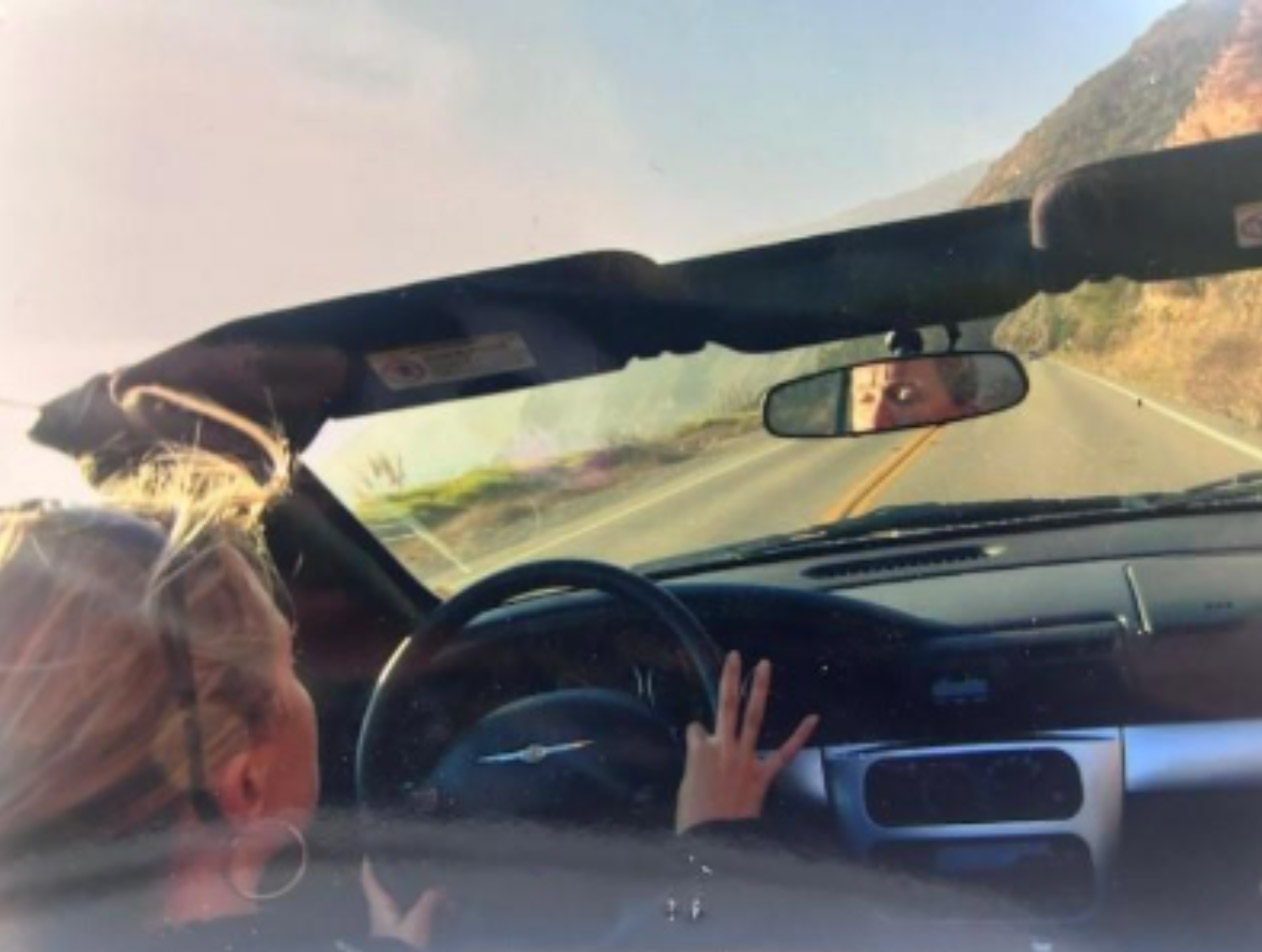
I found a photo that represented the freedom I was craving. It was a holiday snap my husband had taken of me in 2006. Pre-children, both on career highs, we were living our best lives in the USA. In the picture I’m driving a convertible on a beautiful road in California. It was a powerful reminder of my excitement for my then brand-new career as an independent coach, my access to incredible learning, and the euphoria of self-employment freedom after over-working in corporate for the previous decade.
To get clear on my freedom vision, I wrote a simple document describing what I wanted to achieve – titled “I Want”. It included the type of clients I wanted to be working with, the kind of work we’d be doing together, the impact it would have. It also included the way I would be working, with plenty of breathing space and time to myself. My coaching with Gail helped me to deepen my awareness of how it would feel to be living that reality. This is a critical piece of making a change happen – how will it feel?
“Visualisation is not just about creating an image of what you want but also about imagining what it would feel like if you were really in that picture. Everything from the taste in your mouth (the taste of success), the smells around you (fresh paint of a new home, food-related smells in a certain career, your favourite perfume for special occasions), what you are hearing (applause, congratulations, music), and hugely importantly, the physical feeling in your body of achieving this (how does happiness or confidence actually feel?). The more we practice this, the more likely we are to start noticing when it is happening.” Dr Tara Swart, The Source.
To align my behaviour and ‘embrace gratitude without caveats’ as Roxie instructed, I got into a few daily habits that I stuck to every single working day, Monday to Friday, for most of 2025:
- I downloaded two recordings from Roxie’s website, a Manifestation Meditation and one of Affirmations. Possibly the best £12 I have ever spent.
- I started my work day with a morning ritual of my favourite scented candle, Roxie’s Manifestation Meditation, reading my ‘I Want’ statement, and looking at the California picture.
- I doubled down on my daily gratitude practice, spending a few minutes every day writing down what I’m grateful for. I used it to remind myself that plenty of what I wanted was, in fact, already in place.
- I listened to Roxie’s Affirmations every day, while walking or doing other tasks.
And then, in early March, the magic happened. Eleven new coaching clients arrive out of the blue, before I’d even communicated to my network that I was available. This type of work was exactly what I wanted. I knew it was going to allow me to have a positive impact on the world, generate plentiful income and allow me the freedom of more time. It gave me the confidence to set up a new limited company, invest in great people for marketing support, and starting telling people I was available for coaching.
And then, in April, things got even better. Nkuzi Change landed another huge contract.
Ironically, after deciding to close the business, this contract meant we had a hugely busy and prosperous year. Elise and Martin asked me to come back to the business for half the week on a fantastic salary, until we close at the end of January 2026.
Later in the year, a wonderful client in a global technology company mentioned that she’d been frustrated with their USA Exec Coaching provider because they didn’t have enough coaches in the UK. She offered to introduce me to them, and to my delight they asked to go through their selection process. It was a daunting process but by the end, I was so pleased I pushed through it. Documenting the evidence of the impact of my work was time consuming but I’m so grateful for it now – it created a huge confidence boost. And then being accepted and invited into the fold of this prestigious organisation felt great, and has ultimately led to a likely book deal with a fantastic US publishing house.
Who knows – maybe those opportunities would have arrived at my door even if I’d not invested in managing my fear and in defining what I wanted. But would I have responded to them with clarity and positivity? I believe that fear and self-doubt would have got in the way of me even noticing the opportunities were there.
So, I want to close on this.
I’m going to make the bold assumption you’ve already identified the fear in your life, which is why you’ve read this far.
The question is, do you choose to continue living with fear – either real or imagined – allowing it to restrict you? Or do you get back into the driving seat of your thoughts and your reality?
You can create new habits that align with what you want and attract the new life and circumstances you deserve.
I would LOVE to hear your questions, feedback, and news about how you get on – please message me here if any of the learning in this piece changes something for you.
If you’re curious about building confidence in general, I have a gift for you. Elise and I have compiled the best tools and resources from decades of experience of working with people in large organisations who want to improve their confidence at work. We call it the ‘Bold as Brass Self-Coaching Playlist’ and it’s a fantastic curated list of resources, perfect for someone who is ready to invest in their learning but who doesn’t yet have budget to hire their own coach. It can be downloaded for free via the Link tree in my Instagram bio.

Hello, I’m Kate, C-suite coach and workplace relationship expert.
I’ve been coaching executives since 2005, partnering with hundreds of leaders in some of the world’s most respected organisations. I help my clients build influence, improve relationships, set healthy boundaries, and connect to a bolder version of themselves.
I share honest insights for senior leaders navigating tough relationships with their boss, especially when it’s affecting confidence, influence or energy.
If you’re ready to lead with more clarity, connection and strength… Follow me on Instagram and LinkedIn for stories, practical tips, and mindset shifts.

This content is in my name AND I give full credit to my dear friend Elise Finn for this and other content I share.
Elise and I have worked together for more than a decade. Elise asked me to coach her in her role as CMO at Thomson Reuters. More recently we co-founded and ran Nkuzi Change together (helping more than 3000 leaders change their team culture). Elise’s insight shapes my work and she wants to share the wisdom of her significant 40 year career.
Let us know if this is content is helpful – and what you’d like to see more of.
Connect with us on LinkedIn: Kate Franklin and Elise Finn, and follow me on Instagram.
Home | About Kate | Team Development | Resources | Contact | LinkedIn | Instagram | Data Policy | Privacy Policy
Photography by @momentswithNadine and Luke Cole